
Powering South Africa’s future: Will green hydrogen and PtX have a role to play?
Model-based insights on cost-efficient pathways for renewables, hydrogen, and synthetic fuels to 2050
Authors:
Lukas Jansen (Fraunhofer Institute for Energy Economics and Energy System Technology)
Estefanía Duque Pérez (Fraunhofer Institute for Energy Economics and Energy System Technology)
Jochen Bard (Fraunhofer Institute for Energy Economics and Energy System Technology)
Benedikt Häckner (Fraunhofer Institute for Energy Economics and Energy System Technology)
Storm Morison (Stellenbosch University)
Prof. Bernard Bekker (Stellenbosch University)
Frank Muenk (GIZ)
Zaffar Hussain (Agora Industry)
Abstract:
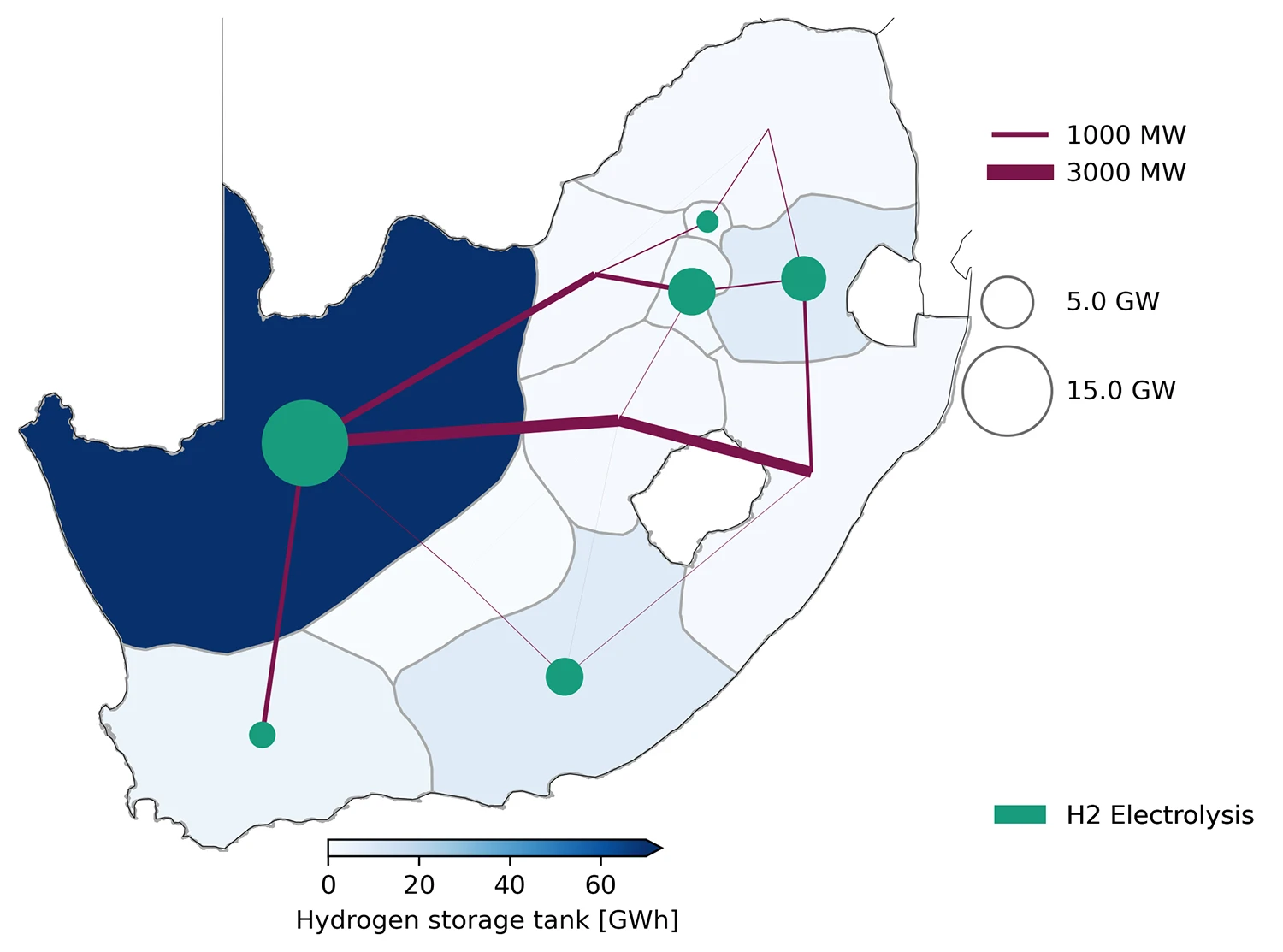
The Power-to-X (PtX) Allocation Study for South Africa, led by the International PtX Hub and conducted by Fraunhofer IEE and Stellenbosch University, explores how renewable electricity can be used to produce green hydrogen and synthetic fuels to support a resilient, net-zero energy system.
The study develops the first open-source, multi-sector, multi-regional, hourly-resolved energy system model for South Africa, known as PyPSA-RSA-Sec. Using this model, three scenario pathways are analysed for 2030–2050: a Current Policy case, a Resilient Net-Zero case, and a Net-Zero Early Export case. These scenarios test different levels of renewable energy expansion, PtX adoption, and export potential, aligned with South Africa’s Just Energy Transition Investment Plan (JET-IP), Transmission Development Plan (TDP), Green Hydrogen Commercialisation Strategy (GHCS)), industry reports, and global hydrogen trade studies.
Results show that electricity consumption could increase by two to four times, with up to half used for green hydrogen production in the high-export scenario by 2050. Meeting this demand will require a massive scale-up of solar and wind capacity (up to ten times today’s coal fleet) and significant investment in grid infrastructure, battery storage, and hydrogen transport networks.
The analysis highlights South Africa’s strong natural and industrial advantages for PtX development but underscores the need for coordinated planning, accelerated renewable build-out, and supportive policies. The study provides a model-based framework to assess trade-offs and identify least-cost pathways for integrating green hydrogen, synthetic green Fischer-Tropsch and methanol fuels, green methane, and green ammonia (with desalinated seawater, nitrogen, and usable carbon dioxide feedstocks) into South Africa’s long-term energy transition. The results are shaped by assumptions for 2030–2050 and should be seen as modelled scenarios rather than forecasts – as they depend on changing economic, policy, and technical conditions.
Categories:
reference:
L. Jansen, E. Duque Pérez, J. Bard, B. Häckner, S. Morison, B. Bekker, F. Muenk, and Z. Hussain, “Power-to-X Allocation Study for South Africa: Power-to-X to Enable and Advance the Long-Term Transformation of South Africa’s Energy System,” International PtX Hub, Deutsche Gesellschaft für Internationale Zusammenarbeit (GIZ) GmbH, Berlin, Germany, Jun. 2025.
Publication date:
June 2025