
Net Zero CO2 Emissions Pathways for South Africa
An evaluation of the techno-economic feasibility of forty distinct decarbonisation pathways for South Africa
Authors:
Andrew Marquard, Guy Cunliffe, Bryce McCall, Julia Tatham, Tara Caetano, Alison Hughes, Bruno Merven, Harro von Blottnitz, Joseph Masenda, Savanha de Kock and Natasha McDaid
Abstract:
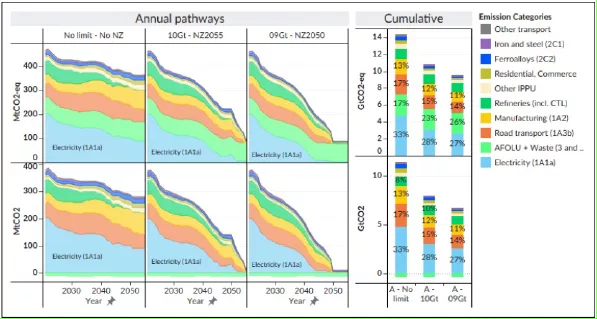
This technical report employs the SATIMGE coupled energy-economic modelling framework to evaluate the techno-economic feasibility of forty distinct decarbonisation pathways for South Africa. The study interrogates the socio-economic ramifications of achieving net zero CO₂ emissions by 2050 and 2055 under varying cumulative emission budgets (8–11 Gt CO₂-eq) and divergent global climate regimes.
Central to the analysis is the finding that the rapid decarbonisation of the electricity sector is the necessary predecessor for economy-wide mitigation, necessitating an aggressive expansion of renewable generation to supersede coal assets. For hard-to-abate industrial sectors, the pathways rely on extensive electrification, energy efficiency, and the deployment of nascent technologies, specifically Carbon Capture and Storage (CCS) and green hydrogen, to mitigate residual emissions.
Economically, the analysis demonstrates that a 10 Gt CO₂-eq trajectory functions as a Pareto-optimal “no-regrets” intervention, yielding GDP outcomes commensurate with baseline scenarios absent further climate policy. However, accelerated pathways to net zero by 2050 precipitate a 4–6% contraction in GDP relative to baseline, attributed to the “crowding out” of capital investment from productive sectors to energy sector mitigation. The report concludes that these macroeconomic costs are not intrinsic but may be amended through the mobilization of international concessional finance, the implementation of rigorous energy efficiency mandates, and the localisation of green manufacturing value chains.
Categories:
reference:
Publication date:
May 2025